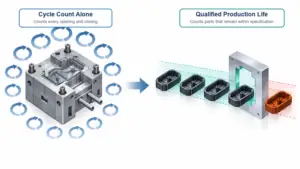
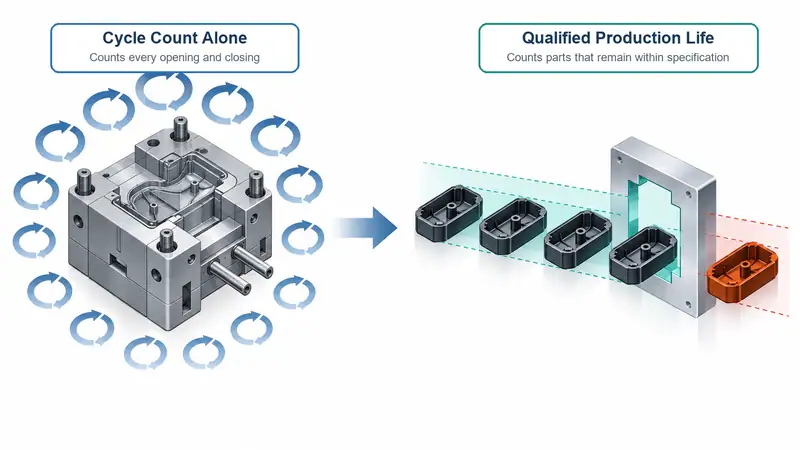
Mold life is not determined by cycle count alone. In injection molding, the plastic resin being processed and the steel selected for the tool are two of the biggest factors behind how long a mold can maintain part quality, dimensional consistency, and stable production.
When we review a new injection molding project, we do not treat the mold as an isolated purchase. We look at the resin, annual volume, part geometry, cosmetic requirements, molding conditions, and maintenance plan together. That approach helps us select a tooling solution that fits the real production requirement rather than simply choosing the lowest initial-cost material.
What Does Mold Life Mean?
Mold life is the number of molding cycles a tool can reliably complete before major repair, reconditioning, or replacement is required. A mold may still open and close after visible wear has begun, but its useful production life is reduced once it can no longer consistently meet the required part specification.
Typical signs of mold-life deterioration include:
- Flash at the parting line
- Dimensional drift in critical features
- Wear on gates, runners, slides, and ejector pins
- Surface defects or loss of texture
- Corrosion marks in cavities or cooling channels
- Longer cycle times caused by cooling or ejection problems
For B2B buyers, the key question is not simply, “How many shots can this mold make?” It is, “How many qualified parts can this mold make under our actual material and operating conditions?”
1. Product Material Has a Direct Effect on Mold Wear
The resin used for the final product creates mechanical, thermal, and chemical demands on the tool. Two molds with the same geometry can have very different service lives when one runs commodity polypropylene and the other runs glass-filled nylon.
Abrasive fillers and reinforcements
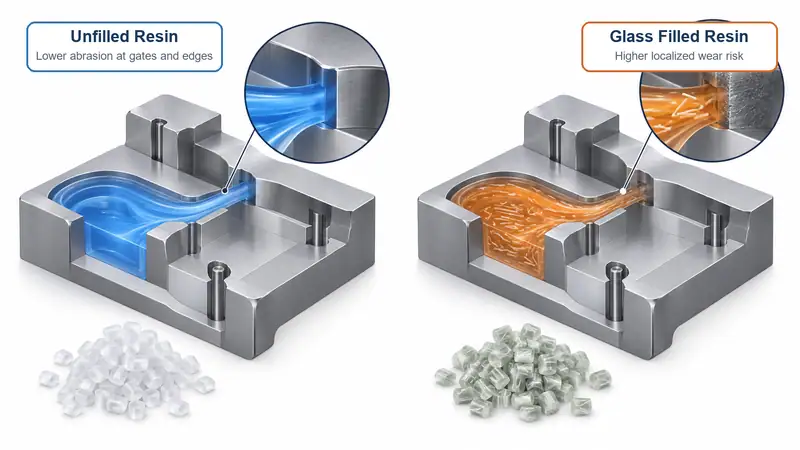
Filled engineering resins are among the most important material-related factors. Glass fiber, mineral fillers, carbon fiber, and certain flame-retardant additives can increase abrasion as material flows through gates, runners, cavities, and high-velocity transition areas.
Glass-fiber-reinforced PA, PBT, PPS, and similar materials are often selected for automotive, electrical, and industrial products because they offer strength and thermal performance. However, the fibers can gradually wear edges, gates, shut-offs, and fine surface details.
We pay particular attention to:
- Gate land and gate insert wear
- Thin ribs and sharp cavity edges
- Slides, lifters, and moving shut-offs
- Textured or polished cosmetic surfaces
- High-flow areas near the gate
For abrasive materials, it is usually more economical to invest in suitable steel, localized inserts, or wear-resistant surface treatment from the beginning.
Processing temperature and pressure
High-temperature resins place more thermal stress on the mold. Materials such as PC, PA, PBT, PPS, PEI, and PEEK may require higher melt and mold temperatures than PP or PE. Repeated heating and cooling cycles can contribute to thermal fatigue, especially where cooling is uneven or mold sections are thin.
High injection pressure also increases stress at the parting line, cores, cavity inserts, and shut-off surfaces. Complex thin-wall parts, long flow paths, or restrictive gates can require elevated pressure. If the mold structure and steel selection are not matched to these conditions, wear and deformation may appear earlier than expected.
Chemical behavior and corrosion
Some resins and additives can create corrosive conditions, particularly if moisture control and process settings are poor. PVC is a familiar example, but corrosion risk can also arise from flame-retardant formulations, recycled content, or resin degradation caused by excessive residence time.
Corrosion can damage cavity surfaces, venting areas, cooling circuits, and parting-line details. It may also make release less stable, leading to scratches, sticking, or increased ejection force.
For corrosion-sensitive applications, we generally consider stainless mold steels or corrosion-resistant inserts, together with proper venting, drying, cleaning, and storage procedures.
Part geometry and resin flow
The product design interacts with the material to influence mold life. Sharp corners, deep ribs, undercuts, thin walls, and long flow lengths can all intensify stress or localized wear.
For example, a glass-filled resin flowing at high speed through a narrow gate can erode the gate area faster than an unfilled resin. Similarly, a part with deep ribs may create higher ejection loads, increasing wear on ejector pins and core features.
A practical DFM review should assess resin flow behavior, wall thickness, gate location, draft angle, cooling layout, and likely ejection force before finalizing the tool design.
2. Mold Material Determines How Well the Tool Resists Wear
The mold material must be selected according to resin, volume, accuracy requirements, surface finish, and production environment. There is no single “best” mold steel for every injection mold.
Hardness and wear resistance
Harder steels usually provide better resistance to abrasive wear, particularly when running filled engineering plastics or high-volume production. Hardened tool steels are common choices for cavity and core components that face repeated contact and high stress.
However, hardness is not the only consideration. A very hard steel may be less forgiving in certain impact-loaded or complex tooling areas. The right solution often combines different steels or inserts in different zones of the mold. For example, we may use a durable pre-hardened base material for the mold structure while specifying hardened inserts for gates, cores, shut-offs, or highly abrasive areas.
Toughness and resistance to cracking
Toughness matters where the mold contains thin cores, deep cavities, sliders, lifters, or features exposed to repeated mechanical loading. A steel that is highly wear-resistant but insufficiently tough may be more vulnerable to chipping or cracking under certain conditions.
This is why mold material selection should follow the part geometry and mold mechanism—not only the resin data sheet. High-strength material alone cannot compensate for an unsupported core, poor shut-off design, or inadequate alignment.
Corrosion resistance
For humid production environments, long-term storage, cooling-water exposure, or corrosive resins, corrosion-resistant mold materials can protect both appearance and function. Stainless tool steels are frequently selected for medical, food-contact, optical, or corrosion-sensitive applications, although the final selection depends on the required polish, hardness, machining needs, and budget.
Good corrosion resistance also supports more stable surface quality. This is especially relevant for visible products where rust marks or pitting can quickly become cosmetic defects.
Surface treatment and coatings
Surface treatments can extend mold life by improving hardness, release, lubricity, or corrosion resistance. Common options include nitriding, chrome plating, PVD coatings, and specialized treatments selected for the application.
A coating is not a substitute for appropriate base steel, but it can be a valuable additional layer of protection. For example, a wear-resistant treatment may be useful on slides, cores, gate components, or surfaces exposed to reinforced resin flow.
3. Matching Product Material to Mold Material
The table below provides a practical starting point. Final selection should always consider part shape, annual volume, surface requirement, and the molding process.
| Product material | Main mold-life risk | Tooling approach to consider |
| PP, PE, ABS, PS | Moderate mechanical wear; possible cosmetic demands | Pre-hardened steel for standard production; polished inserts where appearance matters |
| PC, PC/ABS | Higher processing temperature and pressure | Stable tool steel, effective cooling, strong cavity support |
| PA, PBT | Heat, shrinkage variation, possible moisture-related processing issues | Hardened inserts for critical features; controlled cooling and venting |
| Glass-filled PA/PBT/PPS | Abrasion at gates, cavities, and shut-offs | Hardened wear-resistant steels, replaceable inserts, protective treatment |
| PVC or corrosive formulations | Corrosion and material degradation risk | Corrosion-resistant steel, careful venting, disciplined cleaning and storage |
|
High-temperature engineering resins |
Thermal fatigue, pressure, and wear | High-performance steel, robust cooling design, validated process window |
4. Other Factors That Shorten Mold Life
Although product and mold materials are central, several production factors can accelerate wear.
Poor process control
Excessive clamp force, injection pressure, injection speed, or melt temperature can stress the mold beyond its intended operating window. Unstable settings also make it harder to distinguish normal wear from process-related damage.
Inadequate cooling-water management
Scale, corrosion, and contamination in cooling channels reduce heat transfer. As cooling becomes less efficient, cycle time may increase and temperature variation can affect part quality. Preventive flushing and water-quality control protect both cooling performance and mold life.
Misalignment and mechanical maintenance
Guide pillars, bushes, ejector systems, slides, and locking surfaces require routine inspection and lubrication. Minor alignment issues can become serious wear problems when left unattended, particularly in multi-cavity or high-volume tools.
Improper storage
A mold stored without cleaning, rust prevention, or protective packaging may corrode before the next production run. Before storage, we recommend removing residue, checking the cooling circuit, applying suitable rust protection, and recording the mold condition.
5. How We Protect Mold Life During a Project
The most effective strategy is to make mold-life decisions before machining starts. In our project reviews, we recommend confirming the following points early:
- Specify the exact resin grade, including glass-fiber percentage, flame retardants, recycled content, and colorant where relevant.
- Define expected annual and lifetime volume rather than providing only the first order quantity.
- Identify critical quality requirements, such as sealing surfaces, tight tolerances, high-gloss finishes, or textured cosmetics.
- Review part geometry through DFM, with focus on gate location, wall thickness, draft, cooling, and ejection.
- Select steel and inserts by risk area, rather than applying one material everywhere.
- Set a preventive-maintenance schedule based on resin, production volume, and the mold’s moving mechanisms.
Partner with Moldie for a Mold-Life Strategy That Fits Your Production
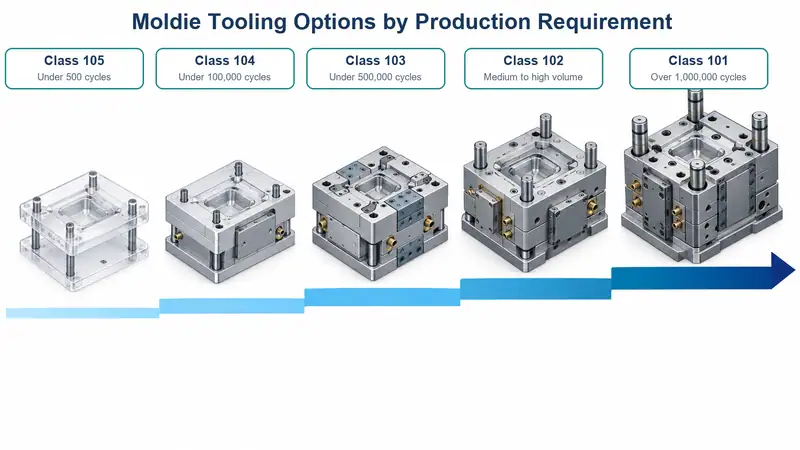
Moldie’s published SPI mold classification lists tooling options ranging from Class 105 prototype molds rated for under 500 cycles to Class 101 production molds rated for more than 1,000,000 cycles.The published range also includes Class 104 tools for under 100,000 cycles, Class 103 tools for under 500,000 cycles, and Class 102 tools for medium- to high-volume programs, including abrasive materials or close-tolerance parts.
For each project, Moldie will confirm the target life together with the exact resin and filler content, annual and lifetime volume, steel grades and hardness, cavity and runner configuration, maintenance intervals, replaceable wear components, and acceptance criteria. A cycle contributes to practical mold life only while the tool continues to produce parts within the agreed dimensional and cosmetic requirements. Contact Moldie to discuss your resin, annual volume, mold-life target, and tooling requirements with our engineering team.