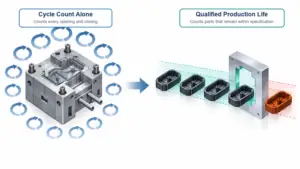
Surface quality is created at two stages. The mold cavity transfers gloss, matte, or texture during molding. Secondary processes such as electroplating, vacuum coating, paint spraying, printing, laser marking, and crystal labels are applied after molding to add color, graphics, metal effects, identification, protection, or electrical properties.
The finish should be defined before tooling release because it can affect resin selection, draft, cavity preparation, gate and ejector locations, masking, inspection, cost, and lead time. Moldie supports both injection mold manufacturing and post-molding surface treatment, allowing these decisions to be reviewed together.
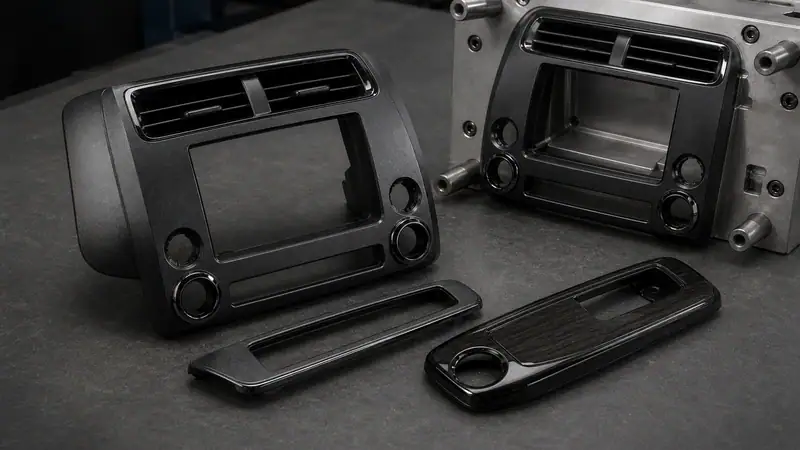
Mold Finish and Secondary Treatment
A mold finish is created on the cavity or core and reproduced on every part. It controls molded gloss, roughness, grain, and pattern without adding a separate film. A secondary treatment is applied to each molded part and can add a coating, printed layer, permanent mark, or label.
| Point | Mold finish | Secondary treatment |
| Stage | Before molding on the cavity or core | After the part is molded |
| Main result | Gloss, matte, roughness, grain, or pattern | Color, metal effect, graphics, marking, protection, or conductivity |
| Key controls | Finish grade, texture code, draft, material, and cosmetic surface map | Compatibility, preparation, masking, cure, adhesion, and functional testing |
The two methods are often combined. A housing may use molded texture on the exterior, pad-printed control icons, and laser marking for traceability. Drawings should identify the treatment and boundary for every cosmetic or functional surface.
Mold Applied Surface Finishes
Polishing produces glossy or transparent surfaces. Abrasive paper and stone create semi-gloss or matte finishes, while blasting, EDM, chemical etching, and laser texturing produce rougher or patterned surfaces. SPI, VDI 3400, and Mold-Tech are commonly used references.
SPI Finish Families
| Family | Method | Typical appearance | Typical Ra µm |
| SPI A-1 to A-3 | Diamond buff | High gloss to normal gloss | 0.012 to 0.100 |
| SPI B-1 to B-3 | Abrasive paper | Fine to normal semi-gloss | 0.05 to 0.32 |
| SPI C-1 to C-3 | Stone | Fine to normal matte | 0.35 to 0.70 |
| SPI D-1 to D-3 | Glass bead or oxide blast | Satin to rough texture | 0.80 to 18.0 |
SPI grades define how the mold is finished, but the final appearance also depends on the plastic. Use a sample made from the production resin and color when cosmetic consistency matters.
VDI and Mold Tech References
| Reference | Surface or depth | Typical result | Draft |
| VDI 12 | Ra 0.40 µm | Low polish | Project specific |
| VDI 18 | Ra 0.80 µm | Satin | Project specific |
| VDI 24 | Ra 1.60 µm | Dull matte | Project specific |
| VDI 30 | Ra 3.15 µm | Coarser dull texture | Project specific |
| VDI 45 | Ra 18.00 µm | Very coarse texture | Project specific |
| MT-11010 | 0.001 in / 0.0254 mm | Fine matte sand-like | 1.5° minimum |
| MT-11020 | 0.0015 in / 0.0381 mm | Medium matte | 2.5° minimum |
| MT-11030 | 0.002 in / 0.0508 mm | Coarse matte | 3° minimum |
Higher VDI values indicate greater roughness. Mold-Tech is specified by a texture code and depth, with more draft required as texture depth increases. Similar roughness values across systems do not guarantee the same gloss or pattern, so critical surfaces should be approved against a named standard and physical sample.
Material Draft and Cosmetic Surfaces
The same mold finish can look different on different materials. Hard plastics reproduce fine texture more clearly than soft materials, dark colors make texture more visible, and glass or mineral fillers can reduce definition or create streaking. Transparent parts normally require appropriate polish on both optical faces.
Texture also affects release. Draft must be checked against texture depth, wall depth, resin shrinkage, stiffness, and ejection direction. Deep ribs and narrow recesses may be difficult to polish or texture consistently. Gate vestige, weld lines, parting lines, and ejector marks should be kept away from critical cosmetic surfaces where practical.
Post Molding Treatments Available from Moldie
| Treatment | Best suited to | Main control points |
| Paint spraying | Multiple colors and smooth uniform coverage on complex shapes | Resin adhesion, preparation, masking, cure, abrasion, chemicals, and UV |
| Electroplating | Bright or matte chromium appearance with possible hardness and corrosion benefits | Compatible substrate, pretreatment, recesses, edges, rack points, and cost |
| Vacuum coating | Thin metallic film or conductive and non-conductive surfaces | Base resin, deposited material, topcoat, masking, and electrical validation |
| Screen printing | Larger graphics on flat or gently curved areas | Ink compatibility, registration, adhesion, and wear |
| Pad printing | Small graphics on curved, recessed, or irregular surfaces | Printable area, registration, ink compatibility, and adhesion |
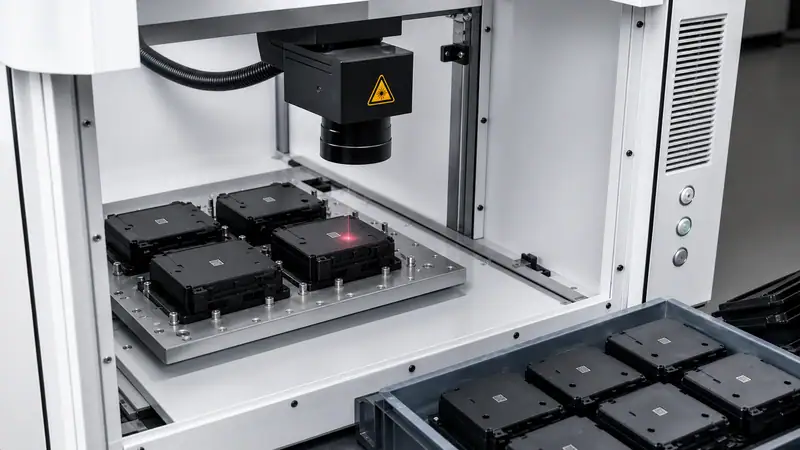
| Laser marking | Permanent logos, symbols, serial numbers, and traceability codes | Contrast depends on resin, pigment, additives, finish, and laser settings |
| Crystal labels | Raised transparent or translucent decorative branding | Placement, edge adhesion, chemical exposure, and service conditions |
Moldie lists bright and matte chromium electroplating, an indium-based non-conductive vacuum coating, an aluminum-based conductive coating, multi-color paint spraying, screen and pad printing, black and gray laser treatments, and crystal labels in multiple patterns.
Electroplating and vacuum coating both create a metal effect, but their process routes and functional results differ. Conductive finishes should be tested electrically rather than accepted by appearance. For printing, screen printing suits broader, flatter areas, while a silicone pad allows pad printing to reach curved or irregular geometry.

How to Choose the Right Treatment
| Required result | Likely route | Confirm before release |
| High gloss or transparency | SPI A or another specified mold polish | Resin clarity, both optical faces, gate, weld lines, ejection, and handling |
| Molded matte or grain | SPI C or D, VDI 3400, Mold-Tech, or custom texture | Standard, grade, draft, texture direction, access, and production-resin sample |
| Specific color or coating effect | Paint spraying | Adhesion, masking, coating system, cure, and service exposure |
| Bright or matte metal look | Electroplating | Substrate, pretreatment, geometry, rack points, and cosmetic criteria |
| Thin metal effect or conductivity | Vacuum coating | Conductive or non-conductive requirement and functional test |
| Graphics | Screen printing or pad printing | Part geometry, color, registration, adhesion, and wear |
| Permanent code or symbol | Laser marking | Contrast and readability on the final resin and molded finish |
| Raised decorative branding | Crystal label | Placement, edge adhesion, chemicals, and operating environment |
Engineering Checklist
- Map cosmetic, functional, masked, and as-molded surfaces on the drawing.
- Specify the finish system and grade instead of using only terms such as matte or polished.
- Confirm the production resin, color, and filler content before final appearance approval.
- Review draft, texture access, gates, parting lines, ejector marks, rack points, and masking boundaries.
- Define relevant abrasion, chemical, UV, humidity, heat, and electrical requirements.
- Approve the actual part in the intended material and process, then record the cosmetic and functional acceptance criteria.
Choose Surface Treatment with Moldie
Moldie can review the resin, mold finish, part geometry, secondary treatment, service environment, and inspection requirements as one production route. Early review helps avoid changes during tooling trials and surface-treatment sampling.
For a technical review, provide the CAD model, resin and color, finish standard, treatment area, annual volume, service conditions, and acceptance requirements. Moldie’s injection molded part surface treatment services or contact Moldie to discuss the process and sample plan.