Lighting plastics form the backbone of nearly every molded component found in modern commercial and industrial fixtures. For engineers, OEM buyers, and product designers, selecting the right resin and optimizing component geometry for the injection molding process is not merely a cosmetic decision.
This article explores the most common molded manufacturing considerations for lighting components, comparing primary resins, outlining critical tooling design rules for injection molding, and explaining how to optimize your parts for high-volume production.
Common Injection-Molded Lighting Components
Injection-molded lighting components span a wide range of shapes and optical requirements. Each presents distinct tooling challenges that affect part quality and production cycle times.
Lenses and LED Optics
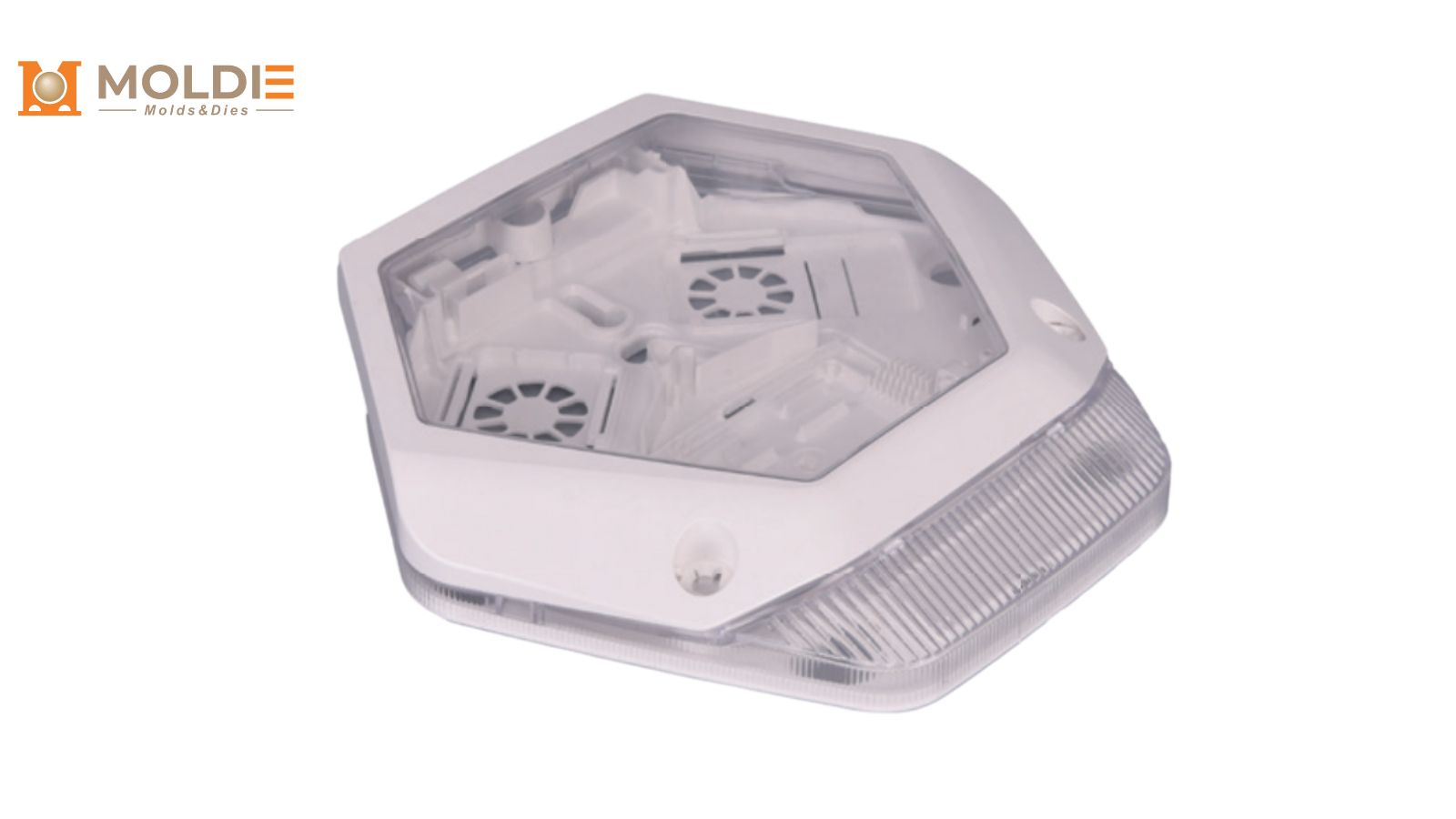
Lenses are the most optically demanding molded parts in a lighting assembly. They control beam angle and intensity distribution. Molding precision LED lenses requires polished optical-grade tooling (often SPI A-1 or A-2 finishes) to ensure maximum light transmittance. Wall thickness uniformity is critical here; even microscopic flow lines or internal stresses caused by improper gate placement can distort the light path and create visible hot spots.
Plastic Light Diffusers
Diffusers are used to scatter concentrated LED point sources into broad, comfortable, and even illumination. While they are a staple in office troffers and linear fixtures, manufacturing them requires precise control of molded-in textures and light-scattering resin additives.
[Read our comprehensive guide on designing and specifying plastic light diffusers to learn more about UGR ratings and frosted finishes.]
Globes, Covers, and Outdoor Enclosures
Light covers serve as the outermost barrier between the light source and the environment. For streetlamps, post-top globes, and vapor-tight fixtures, these enclosures demand complex mold designs, often requiring large core pulls and thick wall sections that increase the risk of sink marks.
[Explore our deep-dive on plastic outdoor lighting for a detailed breakdown of IP ratings, IK impact standards, and UV-stabilized resins.]
Key Resins for Lighting Injection Molding
Material choice drives not only the optical performance but also the moldability and shrinkage rates of the final component. Acrylic and polycarbonate dominate the market.
Acrylic (PMMA) for Maximum Optical Clarity
Acrylic, also known as PMMA (polymethyl methacrylate), delivers up to 92% light transmission in clear grades, making it the closest plastic equivalent to glass. In the injection molding process, PMMA flows predictably and holds extremely tight dimensional tolerances, making it the preferred choice for precision optics and lenses. It also inherently resists UV yellowing better than standard PC.
However, acrylic is brittle. It can crack under sharp impact or during aggressive mold ejection if draft angles are insufficient. It also has a lower heat deflection temperature, requiring designers to ensure LED driver heat does not exceed the resin’s threshold.
Polycarbonate (PC) for Durability and Heat Resistance
Polycarbonate offers roughly 200 times the impact resistance of glass and boasts a significantly higher operating temperature than acrylic. Its light transmission in clear grades reaches approximately 88%.
From a molding perspective, PC has a higher melt viscosity than acrylic, meaning it requires higher injection pressures and mold temperatures. PC excels in outdoor and industrial settings where impact resistance is non-negotiable, though it is highly susceptible to scratching and UV yellowing unless specific UV-stabilized grades are specified before the molding trial.
Supporting Resins (ABS and Polyethylene)
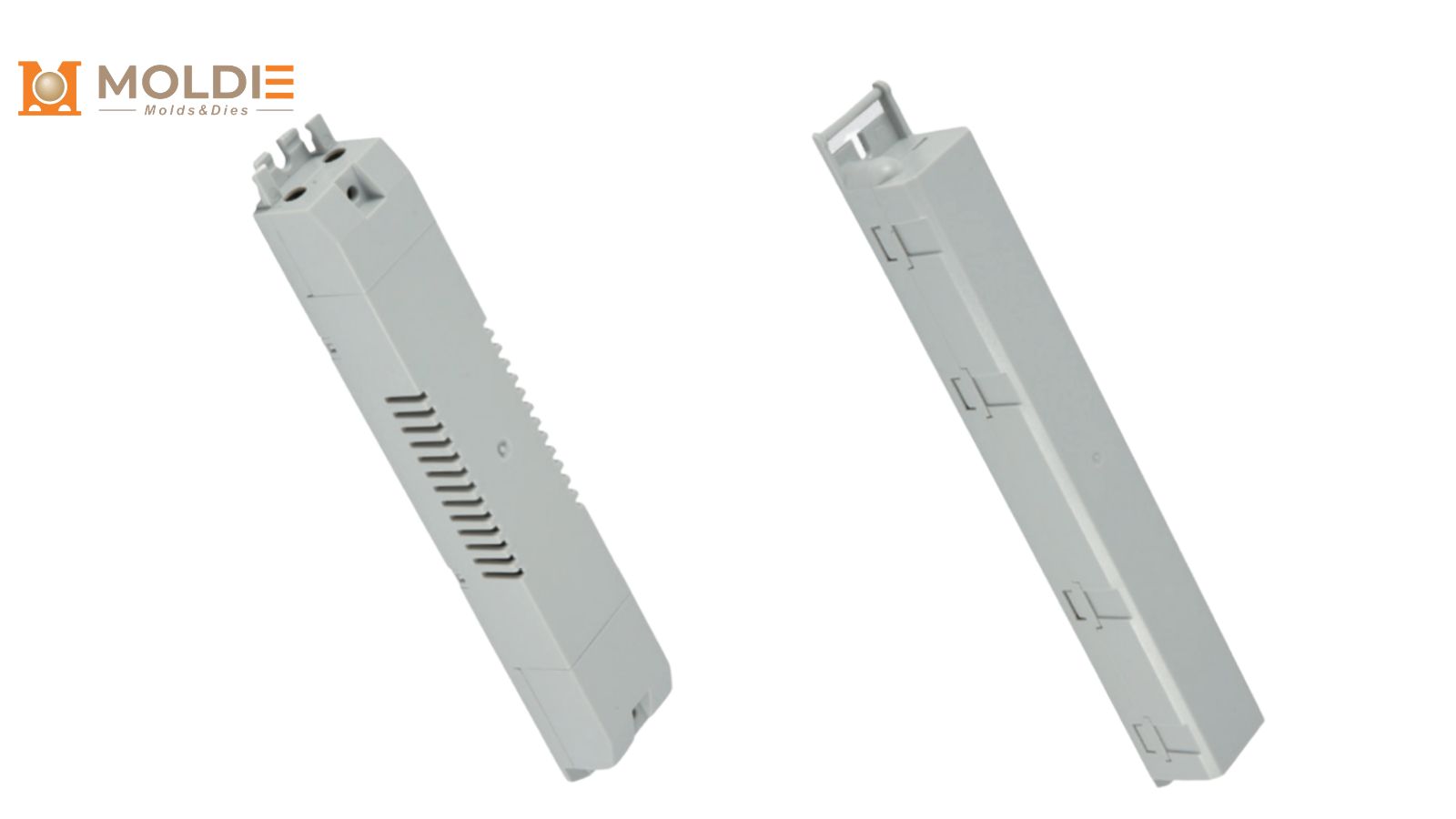
While not used for optics, materials like ABS, High-Density Polyethylene (HDPE), and Polypropylene (PP) are vital for the non-illuminated portions of a fixture. ABS is frequently molded for electrical housings and LED driver enclosures because it molds easily, resists warping, and accepts secondary operations like plating.
Crucial Design Rules for Molding Optical Plastics
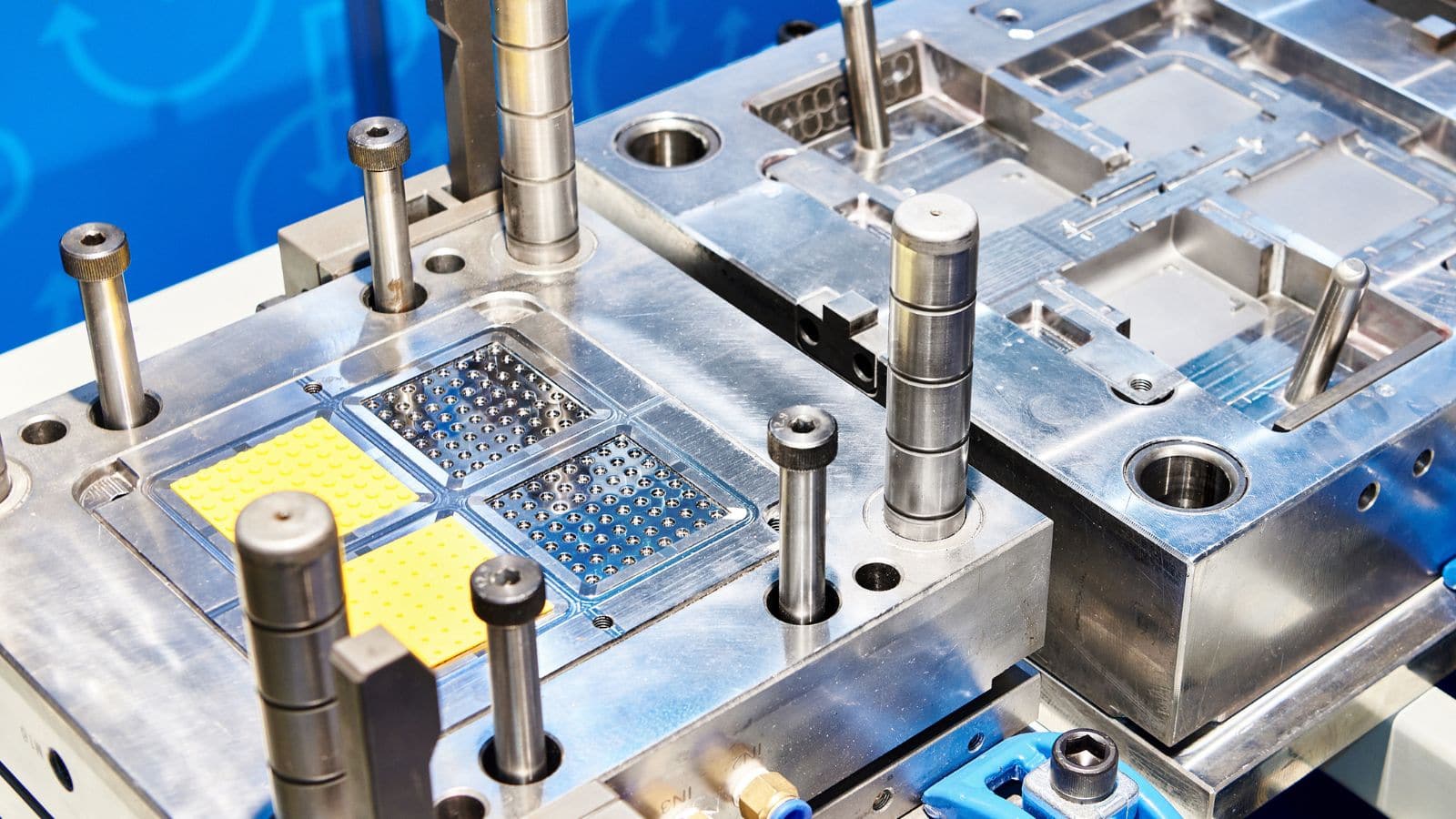
Injection-molded lighting parts are unforgiving when it comes to surface defects. Sink marks, warp, and flow lines that might be acceptable on an internal structural bracket become glaring quality failures on a transparent or translucent optical component.
1. Master Wall Thickness Uniformity
Uniform wall thickness is the golden rule for optical parts. Thick-to-thin transitions create differential cooling rates in the mold. This leads to sink marks on the visible surface and internal stress (birefringence) that bends light unpredictably. If transitions are necessary, they must be gradual.
2. Optimize Ribs and Bosses
Snap fits, screw bosses, and mounting tabs are frequently molded directly into light covers to reduce assembly time. However, these features create thicker cross-sections at their base. To prevent sink marks on the primary optical face, the thickness of any internal rib or boss should be kept to 50% to 60% of the nominal wall thickness.
3. Gate Placement to Prevent Flow Marks
The location where molten plastic enters the mold (the gate) leaves a cosmetic blemish and creates localized stress. For lenses and covers, gates must be placed on non-visible edges or covered by an opaque bezel in the final assembly. Tab gates or fan gates are often used for optical panels to ensure a smooth, laminar flow of resin, preventing jetting and flow lines.
4. Generous Draft Angles for Textured Molds
Surface finishes such as frosting, prism patterns, and matte textures are applied through mold texturing to aid in light distribution. The surface treatment finish chosen at the mold level avoids costly post-processing. However, any textured surface requires higher draft angles to eject from the mold without scratching or dragging. A standard rule is to add 1 to 1.5 degrees of draft per 0.025 mm (0.001 inches) of texture depth.
Partnering with Moldie for Lighting Plastics Solutions
Selecting the correct molded lighting component requires aligning your optical targets, mechanical needs, and production budget. For high-volume LED manufacturing, custom injection molding offers the lowest per-part cost and the ability to integrate mounting hardware directly into the plastic.
Bring your lighting designs to life with Moldie. Partner with us early in your design phase for precision mold flow analysis and high-volume injection molding. We ensure flawless optical lighting solutions at the cost-effective per-part cost.