
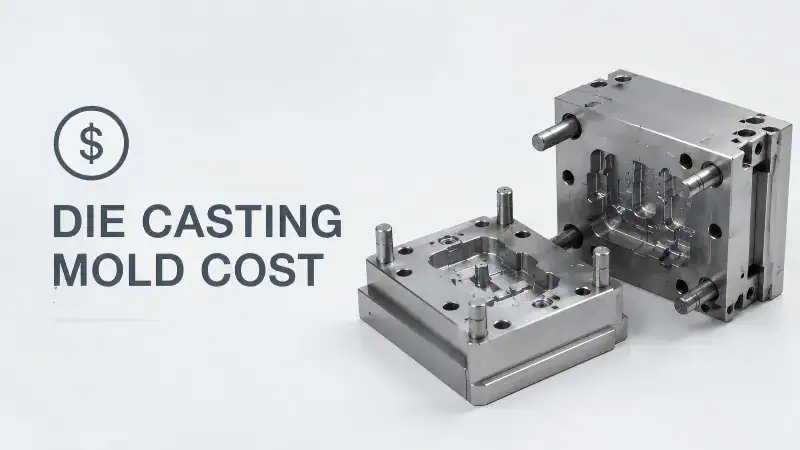
Die casting mold cost can vary widely because each die is engineered for a particular component, alloy, machine, production volume and quality target. A small, straightforward zinc component and a large aluminum housing with multiple slides, vacuum control, trimming and leak requirements are not comparable tooling projects.
For that reason, a reliable price cannot be calculated from part weight alone. Buyers need to understand what is included in the quotation and how the tool will affect finished-part cost over the complete program life.
This guide explains the main cost drivers, common quotation components and practical ways to control die casting tooling cost without compromising production reliability.
What Is Included in Die Casting Tooling Cost?
A complete tooling package may include more than the main die. Depending on the component, the quotation can contain:
- DFM and casting simulation.
- Main die design and manufacture.
- Core and cavity inserts.
- Slides, core pulls and hydraulic components.
- Vacuum valves and related components.
- Trim die.
- Machining fixtures.
- Checking fixtures and gauges.
- Leak-test fixtures.
- Initial trials and samples.
- Dimensional and material reports.
- Spare inserts and wear components.
- Export packaging and shipping.
Before comparing prices, confirm which of these items are included and which are separate.
Part Size and Projected Area
Larger components generally need larger dies, more tool steel, larger machines and higher clamping force. Size also affects machining time, handling, transport and trial cost.
Projected area influences machine selection because the die must remain closed while molten metal fills the cavity under pressure. A larger machine has a higher operating cost, even when the casting itself is relatively light.
Part Geometry and Complexity
Simple open-and-close tooling is usually less expensive than a die requiring side actions. Cost increases when the design contains:
- External or internal undercuts.
- Deep ribs and pockets.
- Complex parting surfaces.
- Multiple slides or core pulls.
- Long or fragile cores.
- Tight access for cooling channels.
- Features that are difficult to eject.
- Cast-in inserts.
Early DFM can sometimes remove an undercut, change a shutoff or reposition a feature to simplify the die. Moldie evaluates manufacturability as part of its mold design and engineering service.
Alloy Selection
Aluminum, zinc and magnesium alloys place different demands on die design, process temperature, machine type and die life.
The selected alloy affects:
- Thermal load on the die.
- Erosion and soldering risk.
- Required die steel and heat treatment.
- Gate and runner design.
- Shrinkage compensation.
- Machine and process selection.
- Expected maintenance.
Moldie provides custom die casting across aluminum, zinc and magnesium systems, including dedicated aluminum die casting support.
Number of Cavities
A multi-cavity die costs more to design, manufacture and balance, but it may reduce the finished-part cost at high production volumes. The correct cavity count depends on:
- Annual demand.
- Part size and shot weight.
- Available machine capacity.
- Cycle time.
- Runner yield.
- Required production rate.
- Risk of cavity-to-cavity variation.
Buyers should compare both the tooling investment and the expected unit cost. The lowest-cost die may not provide the capacity required for the program.
Die Steel, Heat Treatment and Inserts
Die steel must withstand repeated thermal and mechanical loading. The quotation should identify:
- Die block and insert materials.
- Steel supplier or standard.
- Heat-treatment specification.
- Final hardness.
- Surface treatment, when required.
- Replaceable insert strategy.
Higher-quality steel and controlled heat treatment can increase initial cost but improve resistance to heat checking, cracking, erosion and deformation. Replaceable inserts can also reduce future repair cost in high-wear areas.
Slides, Core Pulls and Moving Components
Each moving action adds design, machining, fitting and maintenance work. Hydraulic cylinders, angle pins, locking systems, wear plates, limit switches and connections must all be considered.
Ask the supplier to explain why every slide or core pull is needed. In some cases, a product-design adjustment or a secondary machining operation may be more economical than a complicated die action.
Gate, Runner, Overflow and Venting Design
The metal-delivery system has a major effect on casting quality and yield. Its design must balance filling, solidification, air evacuation, trimming and material consumption.
Additional engineering may be necessary for:
- Thin walls or long flow lengths.
- Critical cosmetic surfaces.
- Leak-tight components.
- Areas machined after casting.
- Structural properties.
- Vacuum-assisted die casting.
Simulation and a well-developed gating strategy add engineering value before tooling, helping reduce expensive trial-and-error modifications.
Cooling and Thermal Control
Cooling channels, baffles, bubblers and localized thermal control affect cycle time and die temperature balance. A more sophisticated cooling layout may cost more to manufacture but support:
- Shorter cycles.
- More stable dimensions.
- Improved die life.
- Reduced soldering or local overheating.
- More consistent casting quality.
Tooling price should therefore be evaluated together with the expected cycle time and process stability.
Trim Tooling and Degating
Most die-cast components require removal of runners, gates, overflows and flash. Depending on geometry and volume, this may be done manually, with dedicated trim dies, or through automated equipment.
A trim die can be a significant separate tooling item. Verify whether the quote includes:
- Trim-die design and manufacture.
- Press requirements.
- Part location and support.
- Piercing operations.
- Scrap separation.
- Maintenance and spare components.
Tolerances and Machining Requirements
Tight tolerances can increase both die cost and downstream fixture cost. The supplier may need additional precision in:
- Insert machining and fitting.
- Slide alignment.
- Die deflection control.
- Process monitoring.
- Machining fixtures.
- Gauges and inspection.
Review which dimensions genuinely need tight tolerances and which should be produced by CNC machining. Mark machining allowances and datum transfer clearly on the drawing.
Surface and Cosmetic Requirements
High-cosmetic components can require additional polishing, texture control, careful gate placement and more restrictive handling. If the part will be plated, anodized, painted or powder coated, the underlying casting quality and surface preparation may also need tighter control.
Include appearance standards and finishing specifications in the RFQ so these requirements are addressed during die design, not after the first trial.
Validation and Quality Documentation
Tooling quotations may differ because one includes a complete validation package and another includes only sample parts. Required deliverables can include:
- DFM report.
- Filling and solidification simulation.
- Die design review.
- Full-dimensional inspection.
- Material certificates.
- X-ray or CT inspection.
- Leak testing.
- Mechanical-property testing.
- Capability studies.
- PPAP documentation.
Clarify the number of trials and samples included, as well as responsibility for corrections and customer-requested changes.
Expected Die Life and Maintenance
A die should be designed for the expected lifetime quantity and operating conditions. Ask the supplier to state:
- Expected die life.
- Warranty conditions.
- Preventive-maintenance recommendations.
- Consumable or excluded components.
- Spare-insert strategy.
- Repair and support arrangements.
A lower-cost die may be appropriate for a limited program. For a long-running component, the cost of downtime and major repairs can outweigh the initial saving.
Need a tooling budget for a die-cast part? Send Moldie your 3D model, drawing, alloy, annual volume and finished-part requirements. We can evaluate the die, trim tooling, machining, finishing and inspection scope and prepare a project-specific quotation. Contact Moldie.
How to Compare Die Casting Mold Quotations
Create a normalized comparison table covering:
| Item | Supplier A | Supplier B | Supplier C |
|---|---|---|---|
| Drawing revision and alloy | |||
| Cavities | |||
| Die steel and hardness | |||
| Slides and core pulls | |||
| Vacuum system | |||
| Expected die life | |||
| Trim die | |||
| Fixtures and gauges | |||
| Trials and samples | |||
| Quality documentation | |||
| Lead time | |||
| Warranty | |||
| Shipping |
Do not compare total prices until the scope is aligned.
How to Reduce Die Casting Mold Cost Responsibly
Cost reduction should remove unnecessary complexity while protecting quality and capacity. Effective approaches include:
- Complete DFM before freezing the design. Removing undercuts or simplifying parting surfaces before tooling is less expensive than modifying steel later.
- Define realistic tolerances. Apply tight tolerances only to functional characteristics.
- Select cavity count from lifetime economics. Avoid both insufficient capacity and unnecessary tooling complexity.
- Use replaceable inserts strategically. Local inserts can simplify repair and accommodate high-wear features.
- Align die life with lifetime demand. Do not overbuild a limited-volume tool or underbuild a long program.
- Combine casting and finishing review. Machining, coating and assembly requirements should influence casting and die design.
- Freeze interfaces before steel cutting. Late changes to sealing faces, connectors or mounting features are costly.
Consider Total Finished-Part Cost
The best-value die is the one that produces acceptable parts at the required rate and total cost. Evaluate:
- Tooling and fixture investment.
- Cycle time and cavity count.
- Alloy yield and return material.
- Scrap rate.
- Trimming labor.
- Machining time.
- Finishing and testing.
- Preventive maintenance.
- Downtime and repair risk.
- Packaging and logistics.
A more expensive die with stable thermal control, efficient trimming and reduced machining may deliver a lower lifetime cost.
Request a Die Casting Mold Quotation
Die casting mold cost is best understood as an investment in capacity, quality and lifetime production economics. A transparent quotation should show the technical solution, included tooling, validation scope and assumptions behind the finished-part price.
Moldie provides die casting mold design and manufacturing together with casting, machining, surface treatment and assembly support. Upload your drawings and requirements through the Moldie contact page to receive a project-specific review and quotation.