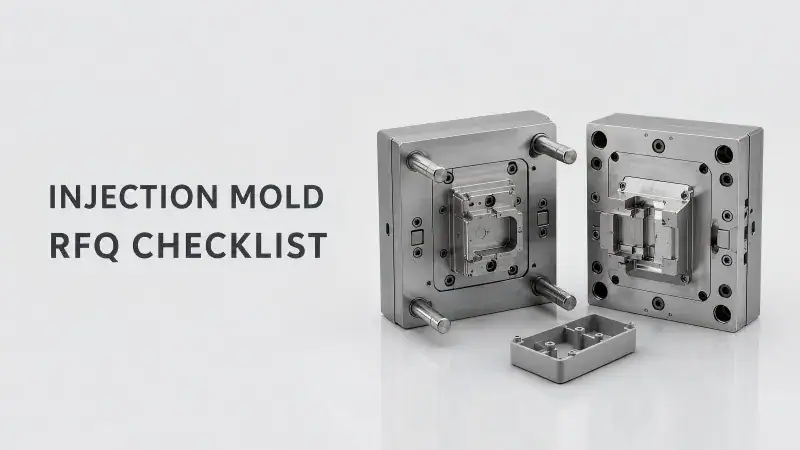
An accurate injection mold quotation starts with an accurate request for quotation. When important project information is missing, a mold maker must either make assumptions or return with a long list of questions. Both situations slow the project down, and assumptions can create major price differences between suppliers.
This injection mold RFQ checklist explains what buyers, sourcing managers and product engineers should prepare before contacting a mold manufacturer. It also shows which details have the greatest effect on tooling cost, mold life, cycle time and part quality.
Why a Complete Injection Mold RFQ Matters
An injection mold is engineered around a specific part, resin, production volume, molding machine and quality target. Two molds that produce parts with the same external shape may require very different steel grades, cooling layouts, cavity counts, hot-runner systems and inspection plans.
A complete RFQ helps a supplier:
- Evaluate manufacturability before quoting.
- Select a suitable mold structure and steel grade.
- Estimate cavity count and cycle time.
- Identify slides, lifters, inserts and other moving components.
- Include the correct inspection, sampling and documentation scope.
- Separate tooling cost from molding and secondary-operation costs.
- Provide a realistic project schedule.
Moldie reviews customer drawings and can support both part optimization and mold design and engineering before tooling begins.
1. Provide a 3D CAD Model
The 3D model is the primary reference for part geometry. STEP or STP is normally the most convenient neutral format, although IGES, X_T and native CAD files may also be useful.
Before sending the model, confirm that it represents the latest revision. The RFQ should state the file name, revision number and release date. If several configurations exist, identify which one should be quoted.
A 3D file allows the mold maker to evaluate:
- Overall part dimensions and projected area.
- Nominal wall thickness.
- Undercuts and side actions.
- Ribs, bosses, snap fits and internal features.
- Potential gate and parting-line locations.
- Ejection and cooling challenges.
If a 3D model is not available, Moldie can also work from 2D drawings or physical samples. Learn more about the required input and engineering process on our How We Work page.
2. Include a Controlled 2D Drawing
The 3D model defines geometry, but the 2D drawing defines what must be controlled. Include:
- Critical dimensions and tolerances.
- Datum systems and GD&T requirements.
- Surface finish or texture specifications.
- Parting-line and gate restrictions.
- Areas where ejector marks are not permitted.
- Color and appearance zones.
- Assembly interfaces.
- Material and regulatory notes.
Avoid applying unnecessarily tight tolerances to every dimension. Tight tolerances can require more precise tooling, additional mold adjustments and more inspection. Mark the characteristics that affect function, sealing or assembly so the supplier can focus engineering effort in the right places.
3. Specify the Plastic Material
Whenever possible, provide the complete resin specification, including:
- Polymer family and commercial grade.
- Manufacturer and grade number.
- Reinforcement percentage, such as 30% glass fiber.
- Flame-retardant, UV-resistant or food-contact requirements.
- Color or masterbatch reference.
- Whether regrind is permitted.
- Required material certificates.
Do not state only “ABS,” “PC” or “nylon” if a particular grade is required. Different grades can have different shrinkage, flow, abrasion and processing characteristics. These differences affect cavity dimensions, gate design, venting and mold-steel selection.
If the material has not been finalized, describe the operating environment and performance requirements. Our custom injection molding team can help evaluate suitable material options.
4. State Annual and Lifetime Production Volumes
The expected volume helps determine the correct tooling strategy. Include:
- Quantity for the first order.
- Estimated annual demand.
- Expected program life.
- Peak monthly demand.
- Number of production locations or molding machines.
A lower-volume program may be suitable for a simpler mold, while a long automotive or industrial program may justify hardened steel, replaceable wear components, a hot runner or additional cavities. Volume information also allows the supplier to estimate whether a higher initial tooling investment could reduce the long-term part cost.
5. Define the Required Mold Life
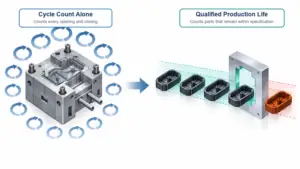
State the expected number of cycles and whether the mold will use abrasive or corrosive material. Mold life should be aligned with lifetime demand, maintenance expectations and spare-part requirements.
Ask the supplier to specify:
- Mold base and insert steel grades.
- Steel hardness and heat treatment.
- Expected maintenance intervals.
- Replaceable wear components.
- Recommended spare inserts and components.
- Mold warranty terms.
Moldie provides custom plastic injection mold manufacturing for prototype, medium-volume and high-volume programs.
6. Provide Part Appearance Requirements
Cosmetic requirements should be established before mold design. Identify:
- SPI polish or texture specification.
- Gloss level and color reference.
- Class-A or customer-facing surfaces.
- Permitted locations for weld lines, gates and ejector marks.
- Requirements for painting, printing, plating or other finishing.
- Visual inspection standard and viewing conditions.
Photographs, finish samples and limit samples are useful when a drawing cannot communicate the required appearance clearly.
7. Describe Assembly and Functional Requirements
Explain how the molded part is used. Important information includes:
- Mating parts and assembly method.
- Sealing, pressure or leak requirements.
- Torque, pull-out or insertion-force targets.
- Electrical insulation or conductivity requirements.
- Operating temperature and chemical exposure.
- Drop, vibration, fatigue or impact tests.
- Post-molding operations such as ultrasonic welding, heat staking or assembly.
Functional context allows engineers to identify risks that may not be obvious from the part drawing alone.
8. Define the Mold Configuration
If your company has tooling standards, attach them to the RFQ. Otherwise, ask the supplier to recommend the configuration. Relevant items include:
- Single-cavity, multi-cavity or family mold.
- Cold runner or hot runner.
- Preferred hot-runner brand.
- Automatic or manual degating.
- Mold base standard.
- Hydraulic, pneumatic or mechanical actions.
- Required cycle-time target.
- Mold dimensions and weight limitations.
If the mold will run in your own facility, provide the molding-machine specifications, tie-bar spacing, platen size, shot capacity, nozzle details, locating-ring size, ejection arrangement and available utilities.
9. List Sampling and Quality Documentation
State the approval process at the RFQ stage. Your requirements may include:
- DFM report.
- Moldflow analysis.
- Mold design review.
- T0, T1 and subsequent trial reports.
- Full-dimensional inspection report.
- Material certificate.
- CMM or 3D scanning report.
- Process parameter sheet.
- First Article Inspection or PPAP documentation.
- Capability studies for critical dimensions.
- Mold-trial videos and photographs.
Defining these deliverables early prevents documentation and testing from becoming unexpected additions later.
10. Clarify the Commercial Scope
Ask for a quotation that clearly separates:
- DFM and engineering.
- Mold construction.
- Hot-runner or purchased components.
- Mold trials and sample quantities.
- Part molding cost at specified volumes.
- Resin and colorant.
- Inserts and secondary operations.
- Inspection and documentation.
- Packaging and shipping.
- Duties or taxes, if applicable.
Also state the required Incoterm, delivery destination, quotation currency and requested project timing.
Have a mold project ready for review? Send Moldie your STEP file, 2D drawing, material, annual volume and quality requirements. Our engineering team can review the project and prepare a tailored tooling and production proposal. Request a quote.
Injection Mold RFQ Summary Checklist
Before submitting your RFQ, confirm that it contains:
- Latest 3D CAD model.
- Controlled 2D drawing.
- Resin grade and color.
- Annual and lifetime volumes.
- Required mold life.
- Appearance and surface requirements.
- Functional and assembly requirements.
- Preferred mold configuration.
- Production-machine information.
- Quality and documentation requirements.
- Secondary operations and packaging.
- Delivery location and schedule.
Frequently Asked Questions
Can I request a quote without a final 3D model?
Yes. A preliminary estimate may be possible from a 2D drawing, concept model or physical sample. However, a final quotation normally requires controlled geometry and clearer specifications because tooling cost depends heavily on part structure.
Should I sign an NDA before sending drawings?
If the product design is confidential, arrange an NDA before sending sensitive files. The RFQ should also identify the document revision and authorized recipients.
How many suppliers should receive the same RFQ?
There is no fixed number, but every shortlisted supplier should receive the same technical and commercial scope. Otherwise, the resulting quotations cannot be compared fairly.
What if the resin or mold configuration is not decided?
Describe the application, production volume, target price and performance requirements. An experienced supplier can recommend a resin and tooling approach, but the assumptions should be written into the quotation.
Get an Accurate Injection Mold Quote
A good RFQ is more than a request for a price. It establishes the technical baseline for mold design, validation and production. Providing complete information at the beginning reduces assumptions, shortens the quotation cycle and makes supplier comparisons more meaningful.
Moldie supports customers from part review and DFM through mold manufacturing, trials and custom injection molding. Upload your drawings and project requirements through our contact form to receive a customized quotation.