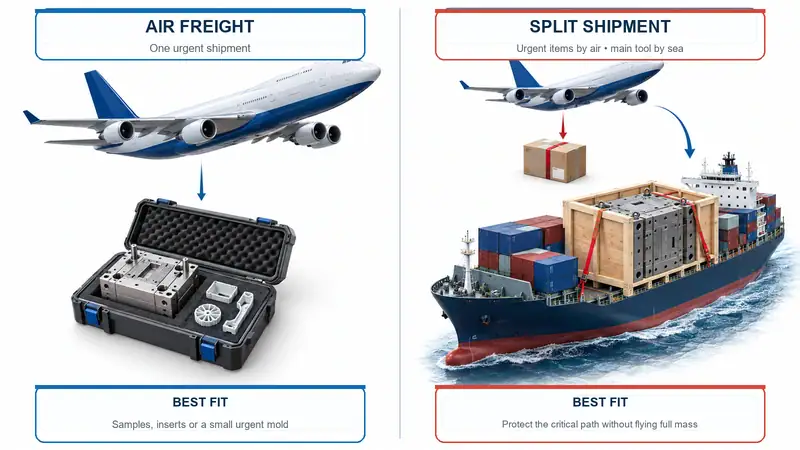
For injection molds, air freight is usually the fastest international mode, but the best choice depends first on what is moving, its packed size and weight, and the date it must arrive.
Moldie’s official workflow separates project review, DFM and simulation, tool design and manufacturing, sampling and validation, and production and delivery. Transit time starts only after technical approval, packing release, booking, and documents are ready—so it should not be treated as the complete project lead time. See Moldie’s custom injection mold services.
What Does “Delivery Time” Include?
A realistic delivery date covers five linked stages, not only the carrier’s main transit:
- Project review: 2D/3D files, material, forecast volume, quality requirements, and target schedule
- DFM and simulation: manufacturability, mold structure, filling, cooling, ejection, and project risks
- Tool design and manufacturing: mold or die construction after design approval
- Sampling and validation: trial parts, inspection reports, corrections, and customer approval
- Packing release: final cargo list, corrosion protection or part packaging, and packed dimensions
- International transport: booking, export clearance, and the air or ocean main leg
- Destination delivery: import clearance, final road leg, unloading, and handover
1. Air Freight for Time Critical Moldie Shipments
Air freight is generally the fastest option. It is most defensible when the business cost of delay is higher than the freight premium—for example, when approval samples, a replacement insert, or a small tool is holding the project’s critical path.
Actual door-to-door time still depends on the origin and destination airports, available aircraft, cargo acceptance, crate dimensions, export and import clearance, and the final road leg. A transit estimate is therefore route-specific, not a fixed promise.
Best Moldie Use Cases for Air Freight
Air freight normally makes sense for:
- T0/T1 trial parts or approval samples
- Urgent replacement inserts, slides, cores, or spare components
- A small prototype or production mold accepted by the airline
- Low-volume, high-value molded or die-cast parts
- A line-down recovery where delay cost exceeds the freight premium
Limits to Confirm
Complete steel molds are dense and expensive to fly. Chargeable weight can be based on actual or volumetric weight, and cargo-aircraft acceptance may depend on the packed dimensions, floor loading, lifting points, and available handling equipment. Moldie and the forwarder need the final crate data before the booking can be treated as firm.
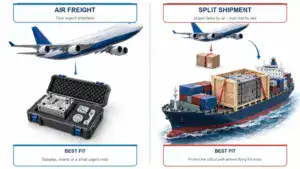
For urgent programs, a split shipment can be more rational: Moldie sends samples, a critical insert, or a replacement component by air while the complete mold travels by sea. This protects the critical path without applying air-freight cost to the full tooling mass.
2. Sea Freight for Complete Molds and Production Cargo
Sea freight is normally the economic baseline for complete production molds, large die-casting dies, multiple tools, fixtures, and palletized production parts. It handles heavy and oversized cargo more efficiently than air, provided the project can absorb a longer and more variable schedule.
Ocean transit is measured in weeks rather than days and can change with the route, transshipment, vessel schedule, equipment availability, congestion, weather, customs, and final delivery. The quotation should therefore record a route-specific planning estimate and a schedule buffer instead of presenting one universal number.
LCL or FCL for a Shipment
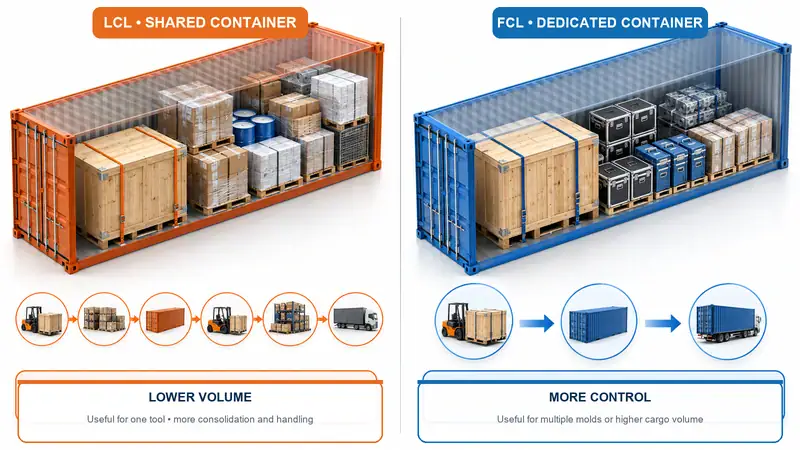
LCL (Less than Container Load) can suit one smaller mold crate that occupies only part of a container. It can reduce the freight charge, but consolidation and deconsolidation add handling points and may increase schedule variation.
FCL (Full Container Load) is usually more attractive for multiple molds, larger tooling, or a combined shipment of molds, spares, fixtures, and production parts. A dedicated container reduces cargo mixing, but the final choice should still be based on total landed cost and handling risk.
Best Moldie Use Cases for Sea Freight
Sea freight is usually the baseline when:
- A complete production injection mold or die-casting die is not on the critical path
- One heavy tool can move by LCL after consolidation and handling are reviewed
- Multiple molds, fixtures, spares, or equipment justify a dedicated container
- Molded plastic parts, die-cast parts, or assemblies fill pallets or containers
- The buyer can plan port, customs, unloading, and final road delivery in advance
Sea freight is slower, but its cost-to-capacity ratio is difficult to match for complete production tooling and repeat production shipments.
3. Road Freight for First Mile, Last Mile, and Regional Delivery
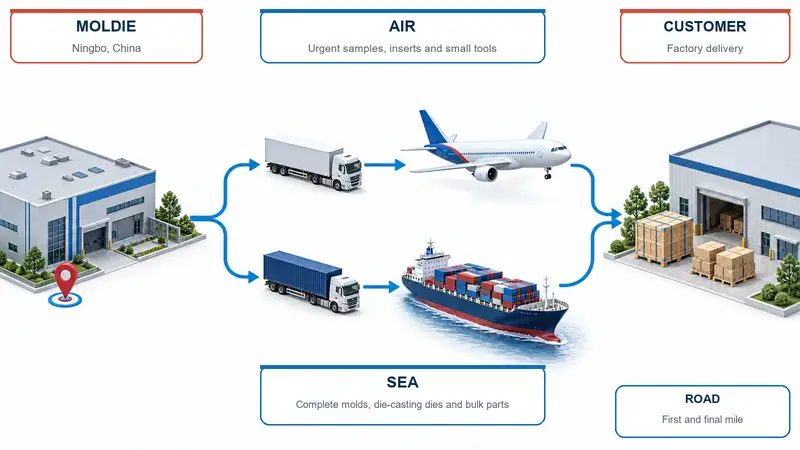
Moldie is based in Ningbo, China. For most overseas projects, road freight connects the Moldie facility to the export airport or seaport and connects the arrival hub to the customer’s factory. Road-only delivery is practical when origin and destination share a workable land corridor.
Direct truck delivery can reduce transfer points and give more control over pickup, appointment, and unloading. This is useful for precision-packed tools, but the vehicle must match the crate weight, dimensions, center of gravity, and loading method.
For cross-border road corridors, time depends on border procedures, route availability, driving rules, security requirements, and customs transit documents. These conditions should be checked lane by lane rather than generalized from a domestic truck schedule.
Best Moldie Use Cases for Road Freight
Road transport is suitable when:
- Moldie cargo must move from the Ningbo facility to an airport or seaport
- Direct delivery is required from the arrival hub to the customer’s factory
- Origin and destination can be linked by a practical regional land corridor
- Cargo dimensions require a dedicated or special-capacity vehicle
- Road is the first or final leg in an air or sea multimodal plan
A complete mold should be blocked and lashed against movement, protected from weather and corrosion, and collected with suitable lifting and unloading equipment. Those requirements belong in the delivery specification, not as assumptions made after the truck arrives.
Air, Sea, Road, and Split Shipment Compared
| Shipping method | Relative speed | Best Moldie cargo | Main trade-off | Confirm before quote |
| Air | Fastest | Samples, inserts, small urgent molds, low-volume high-value parts | Highest cost; airline acceptance limits | Packed size, gross weight, required arrival |
| Sea LCL | Weeks; route-dependent | One heavy mold or partial-container cargo | More consolidation and handling | Port, crate data, handling and insurance |
| Sea FCL | Weeks; route-dependent | Multiple molds, dies, spares, or bulk production parts | Container commitment and schedule buffer | Container fit, loading, unloading and final road leg |
| Road | Fast regionally | First/last mile or regional factory delivery | Border, route and truck constraints | Exact addresses, vehicle, loading and unloading |
| Split shipment | Fastest critical item | Urgent samples or inserts by air; main tool by sea | Two coordinated shipments | Itemized packing list, documents and separate ETAs |
What Can Delay Injection Mold Delivery?
The shipping method is important, but several other factors can affect delivery time.
Mold approval status
A mold should ship only after the agreed trial parts, dimensions, and appearance have been confirmed. Last-minute engineering changes can affect the final dispatch date more than the freight method itself.
Export packing
Injection molds need corrosion protection, mechanical restraint, sealed cooling connections where required, and export-grade packaging. Insufficient packing can lead to damage, rust, or shifting during transport—problems that cost far more time than careful preparation.
Booking and carrier capacity
Air space, vessel schedules, container availability, and seasonal demand influence booking lead time. We recommend confirming the shipping plan before the mold is ready, particularly for urgent or oversized cargo.
Customs documents
Commercial invoices, packing lists, HS codes, consignee information, and any destination-specific documents should be prepared accurately. Incomplete or inconsistent paperwork can delay clearance at either end of the shipment.
Incoterms and destination responsibility
Buyers and suppliers should agree clearly on the delivery term, named place or port, insurance responsibility, import customs responsibility, and final unloading arrangement. A shipment can arrive at the destination port on schedule but still face delay if these responsibilities are unclear.
How to Shorten the Total Delivery Timeline
The fastest logistics plan begins before the mold is complete. We recommend the following actions:
- Confirm the destination address, consignee, and preferred shipping method early.
- Decide whether the priority is lowest cost, fastest arrival, or a balanced approach.
- Provide crate-size, gross-weight, and lifting information before booking.
- Prepare export and import documents before the tool enters final packing.
- Reserve air space or container capacity in advance for critical schedules.
- Allow contingency time for customs, port handling, and final delivery.
- Consider split shipment when a critical insert or spare part can move by air.
For many B2B projects, reducing delay is less about choosing a faster carrier and more about coordinating engineering approval, packing, documents, booking, and import readiness.
Plan Mold Delivery Time with Moldie
Founded in 2008 in Ningbo, Moldie supplies plastic injection molds, die-casting dies, molded and die-cast parts, precision mechanical parts, and assemblies for global OEM/ODM projects. The delivery plan is built around the actual cargo—not a generic “fastest shipping” label.
For a route-specific proposal, send the cargo type, destination, arrival date, Incoterm, packed weight and dimensions, and any critical-path items. Moldie can then compare air, sea, road, and split shipment on the same assumptions and record the selected scope in the quotation.